About St Augustine's Parish and Church
St Augustine of Canterbury
 When Augustine of Canterbury arrived in England in the year 597, he had a very important mission: to bring Christianity to the people of this new land. Although he had originally been a monk back in Rome, he now found himself as the first Archbishop of Canterbury, establishing Christianity throughout England and converting countless people along the way. Despite facing many challenges, Augustine was unwavering in his commitment to spreading the word of God across the English countryside. In fact, he is often referred to as the "Apostle to the English"", as it was his tireless dedication that brought Christianity to this corner of the world. Today, his legacy lives on not only through the many parishes and institutions that bear his name, but also through all those who continue to be inspired by his steadfast faith and determination.
Our Mission as a Parish
Located in the heart of Manchester Metropolitan University, St Augustine's church serves the surrounding community as a sanctuary of peace and prayer amidst a very bustling area.
Everyone is welcome to be part of our community, and we hope you feel it can be your spiritual home. We all have a calling or mission given to us by God; together here at St Augustine's we can fulfil that mission and be a visible and welcoming witness to everyone of the message of God's love. We do that by getting to know Jesus together, realising what he has done for us, and then following his example of serving those around us with love.
Parish Area
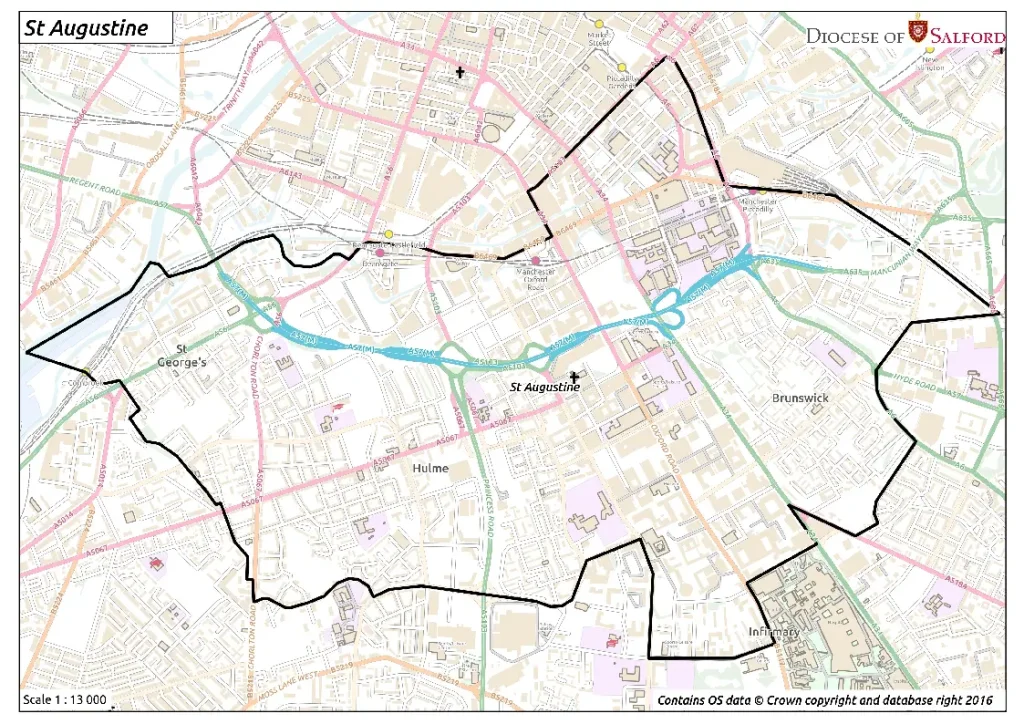
The parish covers all of Hulme, Chorlton-on-Medlock (the Brunswick estate), all the Manchester Universities, and some of the city centre with the border going along Portland Street to Piccadilly train station. It is a very vibrant and diverse area and community!
Click here to see the exact boundaries of our parish.
Deanery of St Ambrose Barlow - South Manchester
The Diocese of Salford has a total of 129 parishes, divided into 8 deaneries. A deanery is a subdivision of a diocese that allows churches in the same area of a diocese to work more closely together and is presided over by a dean. St Augustine's is part of the South Manchester Deanery of St Ambrose Barlow, and we have 21 parishes in the deanery. To learn more about the deanery click here to see all of our parishes.
St Augustine of Canterbury
When Augustine of Canterbury arrived in England in the year 597, he had a very important mission: to bring Christianity to the people of this new land. Although he had originally been a monk back in Rome, he now found himself as the first Archbishop of Canterbury, establishing Christianity throughout England and converting countless people along the way. Despite facing many challenges, Augustine was unwavering in his commitment to spreading the word of God across the English countryside. In fact, he is often referred to as the "Apostle to the English"", as it was his tireless dedication that brought Christianity to this corner of the world. Today, his legacy lives on not only through the many parishes and institutions that bear his name, but also through all those who continue to be inspired by his steadfast faith and determination.
Our Mission as a Parish
Located in the heart of Manchester Metropolitan University, St Augustine's church serves the surrounding community as a sanctuary of peace and prayer amidst a very bustling area.
Everyone is welcome to be part of our community, and we hope you feel it can be your spiritual home. We all have a calling or mission given to us by God; together here at St Augustine's we can fulfil that mission and be a visible and welcoming witness to everyone of the message of God's love. We do that by getting to know Jesus together, realising what he has done for us, and then following his example of serving those around us with love.
Parish Area
The parish covers all of Hulme, Chorlton-on-Medlock (the Brunswick estate), all the Manchester Universities, and some of the city centre with the border going along Portland Street to Piccadilly train station. It is a very vibrant and diverse area and community!
Click here to see the exact boundaries of our parish.
Deanery of St Ambrose Barlow - South Manchester
The Diocese of Salford has a total of 129 parishes, divided into 8 deaneries. A deanery is a subdivision of a diocese that allows churches in the same area of a diocese to work more closely together and is presided over by a dean. St Augustine's is part of the South Manchester Deanery of St Ambrose Barlow, and we have 21 parishes in the deanery. To learn more about the deanery click here to see all of our parishes.
The Story of St Augustine's
The parish of St Augustine’s, situated in Grosvenor Square (All Saints) just off Oxford Road, is one of Manchester's most historic Catholic communities. Located just a short distance north of the Church of the Holy Name, it shares a deep history of serving the city’s university district and urban population.
Deep Historical Roots (1820s)
-
One of Manchester's Oldest Parishes: Founded in 1820 by Fr. Rowland Broomhead, St Augustine’s is the third-oldest Catholic parish in Manchester (after St Chad's and St Mary's "The Hidden Gem").
-
Original Granby Row Site: The original church was built on Granby Row (near modern-day Piccadilly Station) when there were only around 500 Catholics in the entire region.
-
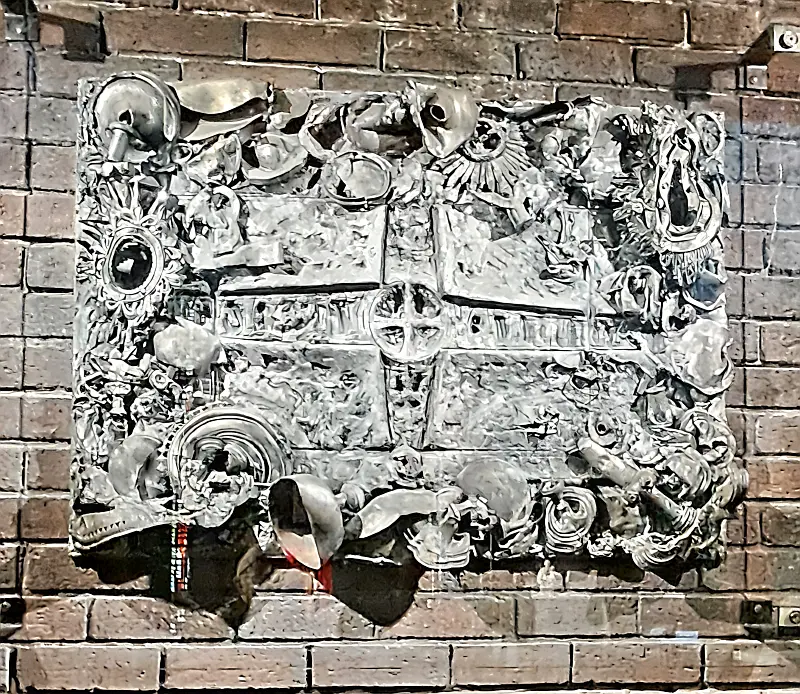
Wartime Destruction: In December 1940, during the Manchester Blitz, the second iteration of St Augustine’s Church (then on York Street/York Road) was destroyed by incendiary bombs. In a poignant detail of survival, crushed chalices recovered from the wartime rubble were later turned into a metallic collage, which remains on display inside the current church.
The Modern Grosvenor Square Church
Following the destruction of its historic home, the parish re-established itself at its current location on Grosvenor Square, previously occupied by a smaller chapel (Holy Family).
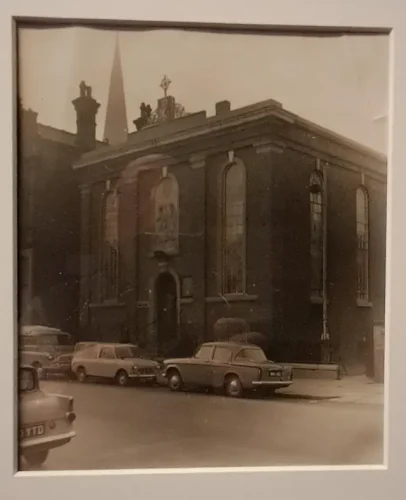
The art and architecture of the Church represent one of the finest examples of post-Vatican II modernist Catholic artwork in the United Kingdom. Designed by architects Desmond Williams & Associates and consecrated in 1970, the church replaced its Victorian predecessor destroyed during the Blitz with an unyielding modern aesthetic built around liturgical renewal.
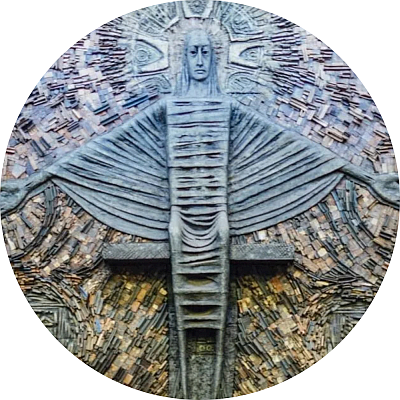
The defining feature of St Augustine’s interior is its massive ceramic reredos wall covering the sanctuary wall behind the altar.
-
Artist & Material: Created by York-based sculptor Robert Brumby, the installation consists of thousands of individual, hand-formed ceramic tiles and shapes glazed in earthy metallic tones of bronze, dark brown, and slate grey.
-
Iconography: The central focus is a large stylized figure of Christ in Majesty with outstretched arms. Surrounding the central figure are dynamic, swirling relief patterns and symbols representing creation, the cosmos, and the Eucharistic mystery.
-
Scale and Impact: Spanning almost the full height and width of the sanctuary wall, the sculpture acts as an immersive backdrop that catches ambient light from the ceiling windows, creating a shimmering, tactile texture during services.
Stained Glass and Lighting
Rather than using traditional framed windows, the design integrates stained glass directly into the structural fabric of the building:
-
Slab Glass Glazing: Designed by glass artist Charles Blakeman, vertical strips of thick, slab-cut French glass (dalle de verre) are set into narrow concrete and dark brick slits along the side walls.
-
Chiaroscuro Effect: The dark interior walls contrast sharply with these vertical light shafts, casting deep blues, golds, and reds across the sanctuary floor without distracting from the central altar.
-
Sanctuary Skylight: A hidden overhead roof light directly above the altar illuminates Brumby’s ceramic reredos, making the central sculpture the focal point of the interior.
Exterior Art and Architectural Form
-
Brutalist Massing: The exterior is clad in dark Staffordshire blue brick with crisp, minimalist lines, presenting a strong, bronze-tinted geometrical mass to Grosvenor Square.
-
Main Entrance Reliefs: The main portal features bronze-clad doors with abstract geometric relief panels that echo the industrial textures of post-war Manchester.
-
Relics of War: Set into the entrance porch is a metallic display case containing salvaged, fire-damaged sacred vessels—including chalices crushed in the 1940 bombing of the original church—serving as a stark artistic reminder of the parish’s survival through WWII.
(Text from Google and other sources)
The Story of the UMIST Chaplaincy
The history of St Augustine’s as part of the student and university ecosystem in Manchester is intertwined with the evolution of the Manchester Universities' Catholic Chaplaincy (MUCC). Because St Augustine’s sits on Grosvenor Square—in the heart of the Manchester Metropolitan University (MMU) All Saints campus and near the historic UMIST site—it has played a distinct structural and physical role alongside the chaplaincy over the decades.
The Historical UMIST Connection
St Augustine’s connection to Manchester’s higher education history goes back to its original location:
-
Granby Row and UMIST: The original 1820 St Augustine’s church stood on Granby Row. In 1905, the parish sold the land and original building to the city to make way for the expansion of the Manchester Municipal Technical College.
-
Educational Legacy: That technical college eventually evolved into the University of Manchester Institute of Science and Technology (UMIST) (which merged with the Victoria University of Manchester in 2004). In a literal sense, the physical foundation of modern science and engineering education in Manchester was built directly on the site of the first St Augustine’s.

Division of Roles: Parish Church vs. Central Student Chaplaincy
While the Manchester Universities' Catholic Chaplaincy (MUCC) and its student center (the Newman Centre) were established primarily adjacent to the Church of the Holy Name on Oxford Road under the direction of the Jesuits, St Augustine’s developed a complementary relationship:
-
Anchor for MMU (Grosvenor Square): When St Augustine's was rebuilt in 1968, its location on Grosvenor Square placed it right inside what became the main campus of Manchester Polytechnic (now MMU). It naturally became the primary house of worship and quiet reflection for Catholic staff and students living or studying on the All Saints campus.
-
Supporting the Central Chaplaincy Team: Rather than running a separate competing chaplaincy, priests at St Augustine’s have traditionally worked alongside the central MUCC team (which comprises Jesuits, religious sisters like the Faithful Companions of Jesus, and lay chaplains). St Augustine’s hosts early morning weekday Masses, quiet Adoration, and parish events that accommodate student schedules.
-
Sacramental & Parish Base: Because Holy Name operates strictly as a university chaplaincy church rather than a canonical territorial parish, major parish-based sacraments (like baptisms, weddings, and local community outreach) for students and university staff residing in the immediate area often flow through St Augustine’s and the Diocese of Salford.
(Text from Google and other sources)
For an interesting article on the importance of St Augustine's from an architectural point of view click here to read an assessment by Adam Brocklehurst.